The conversation around AI in enterprise environments has focused for years on foundation models. More parameters, larger context windows and stronger reasoning capabilities appeared to define competitive advantage. However, as organisations deploy AI into production, the problem is changing radically. What truly matters is no longer just the model itself, but the ability to understand and control how it behaves.
Modern AI systems are no longer simple chat interfaces connected to an LLM. They are distributed architectures composed of agents, RAG pipelines, external tools, vector databases and multiple layers of inference. In this context, observability becomes an essential operational requirement.
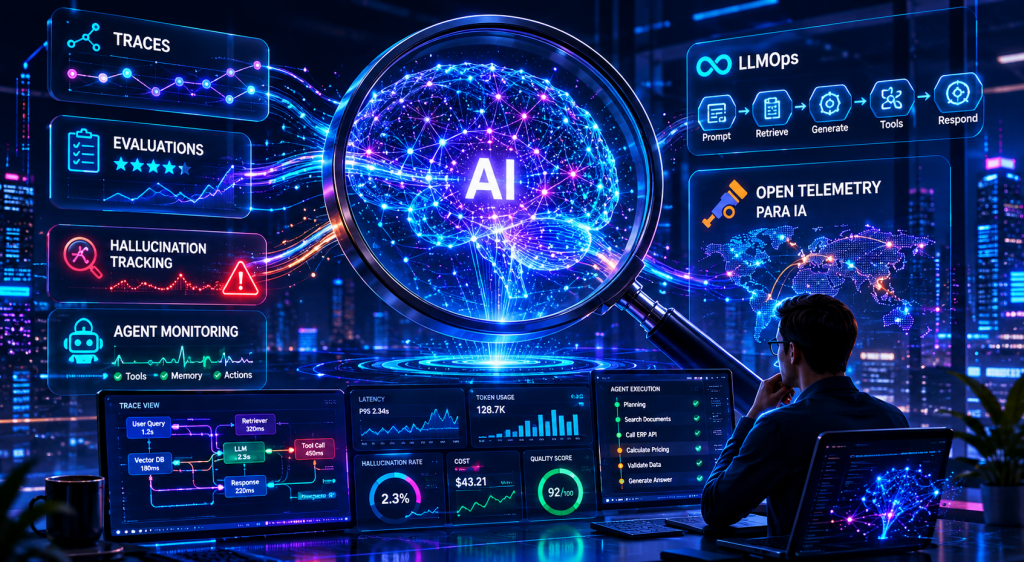
An enterprise system needs to know which prompt the model received, which documents were retrieved, which tools were executed, how long each stage took and why the agent made a particular decision. Traces are starting to play a role similar to the one they had during the evolution of microservices and Kubernetes. Without traceability, operating AI at scale becomes practically unmanageable.
The emergence of autonomous agents increases this requirement even further. When an agent can interact with ERPs, CRMs or cloud platforms, the challenge moves beyond conversation and becomes a matter of auditing, governance and operational control. Agent monitoring is no longer limited to measuring latency or token consumption. It must also detect faulty reasoning, loops, anomalous executions or unsafe tool calls.
Another critical area will be hallucination tracking. In enterprise environments, a hallucination is not simply an incorrect answer. It can become a financial, legal or reputational incident. This is why new platforms are emerging that can measure grounding, semantic consistency and contextual quality across generated responses.
This scenario is also accelerating the adoption of continuous evaluations. Systems built around agents and RAG evolve constantly due to new prompts, documents or tools. Evaluation is no longer a pre deployment exercise and instead becomes part of the daily operational lifecycle.
All of this converges into the growth of LLMOps. In the same way DevOps transformed software delivery and MLOps industrialised machine learning, LLMOps aims to operate generative AI in a reliable, observable and governable way within production environments.
One of the most significant developments is the integration of OpenTelemetry into AI workloads. Telemetry related to prompts, retrievals, inferences and agents is beginning to integrate with the traditional observability platforms already used by SRE and Platform Engineering teams. This enables organisations to correlate AI events with metrics, logs and traces across the wider enterprise infrastructure.
The market is starting to understand that models will increasingly become interchangeable. The real competitive advantage will come from the ability to observe, govern and operate AI securely and efficiently at enterprise scale.
Useful links