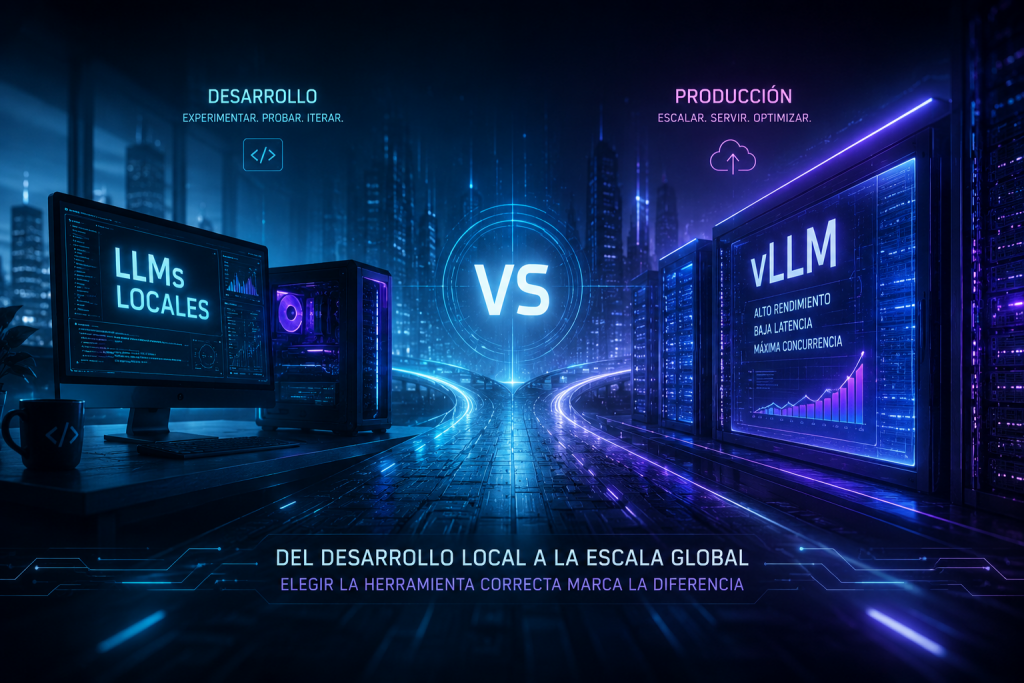
The rapid adoption of language models has led many organisations to reconsider how they run and serve generative AI efficiently. In this context, a key decision often emerges between using locally deployed models through traditional tooling or relying on specialised inference engines such as vLLM.
During development, it is common to work with solutions such as Ollama, llama.cpp, Hugging Face Transformers or direct PyTorch deployments. This approach simplifies prototyping, functional testing and experimentation with prompts, embeddings and agents without the need for complex infrastructure.
The situation changes once low latency, high concurrency and efficient GPU utilisation become critical requirements. A model that performs well in a testing environment can quickly become a bottleneck when required to handle dozens or hundreds of simultaneous requests. This is where vLLM stands out.
vLLM is an inference engine designed to maximise the performance of large language models. Its most significant innovation is PagedAttention, a technique inspired by operating system memory paging that reduces fragmentation and optimises GPU memory usage. As a result, it can significantly increase concurrency and throughput compared with conventional Transformer based implementations.
In addition, vLLM incorporates continuous batching mechanisms that dynamically group multiple requests and make better use of GPU parallelism. In high demand environments, this translates directly into lower operational costs and a better user experience.
From an architectural perspective, local LLMs are generally better suited to proof of concept projects, development environments or applications with relatively few concurrent users. They are also particularly attractive when strict privacy requirements exist or when deployment on edge devices is required.
At the same time, Small Language Models, often referred to as SLLMs, are gaining momentum thanks to their lower resource consumption and reduced operating costs. For specialised tasks or well designed RAG architectures, these models can provide an excellent balance between accuracy, speed and efficiency while also making local deployment more practical.
By contrast, vLLM is clearly designed for production environments. Its compatibility with OpenAI style APIs, quantisation techniques, tensor parallelism and distributed deployments enables the creation of scalable inference platforms capable of serving large models efficiently.
The choice between these approaches should not be viewed as mutually exclusive. A common strategy is to develop and validate applications using local tools before migrating model serving to vLLM once scalability becomes a requirement. This approach combines the agility of local development with the performance and efficiency demanded in production.
As models continue to grow in size and complexity, the inference layer is becoming just as important as the model itself. The difference between running an LLM and serving it efficiently at scale is no longer an implementation detail but an architectural decision with a direct impact on cost, performance and user experience.