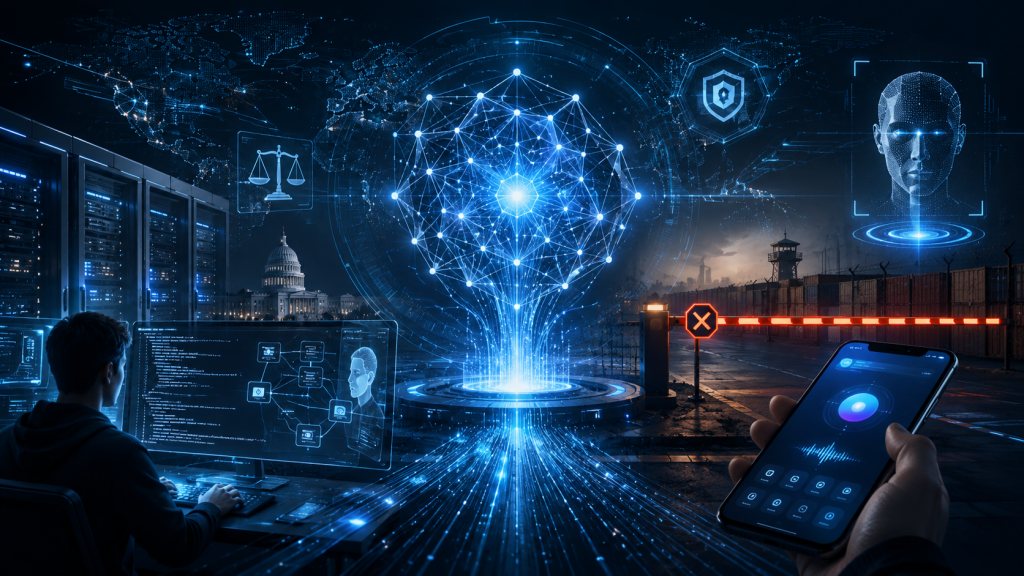
June 2026 showed that the AI race is no longer only about building more capable models. It is also about deciding who can access them, where they run and how much control sits around them.
Claude Fable 5 was the clearest example. Anthropic presented it as a more accessible version of Mythos 5, designed for programming, complex reasoning and long running autonomous work. The important shift is not just better answers. It is the ability to plan, use tools, check results and continue working across longer tasks.
Its launch quickly became political. The US Government applied export controls to Fable 5 and Mythos 5, forcing Anthropic to restrict access for foreign users. The decision was later reversed, but the precedent remains. A commercial AI model was treated as sensitive technology on national security grounds.
The technical concern is understandable. Agentic models do not simply produce text. They can write code, call tools and chain actions together. In that context, a jailbreak is no longer just an unsafe reply. It can become an operational sequence with real consequences. Red teaming work around Fable 5 shows that even advanced safeguards still leave attack surfaces under automated pressure.
Apple is moving in a similar direction, although from a different angle. Its new Siri strategy appears to rely on a customised version of Gemini, while keeping control over the device, the user experience and privacy. The message is clear. Owning the best foundation model is not the only way to compete.
The advantage now also lies in distillation, local execution and deep integration with hardware. Apple can turn AI into a contextual layer across iPhone, Mac and Siri without having to lead the foundation model race itself.
The acquisition of Cursor by SpaceX points to another change. AI assisted software development is starting to merge with companies that control infrastructure and compute. Cursor was already one of the most influential coding tools in the market. Inside SpaceX, it may gain access to more resources, but it could also lose some neutrality as a platform.
This is vertical integration applied to AI. Whoever controls compute, models and tools can iterate faster and reduce costs. The risk is a more closed ecosystem, where developer tools become strategic assets inside large industrial platforms.
Identity is becoming another layer of control. Anthropic has introduced ID and selfie verification for certain uses of Claude. The company says these checks are for identity confirmation and are not used to train models. Even so, the move marks a turning point. Anonymous access to the most powerful AI capabilities is becoming harder to justify.
The comparison with digital banking is useful. As platforms gained the ability to move money and trigger high impact actions, traceability became unavoidable. AI is following a similar path. If a model can act on behalf of a user, identity becomes part of the security architecture.
Europe is trying to build a different answer. Projects such as Apertus focus on open, auditable models designed for stricter regulatory environments. Their value is not only performance. It is transparency, reproducibility and trust.
The direction of travel is becoming clearer. AI is moving from impressive demos into controlled infrastructure. The next phase will not be defined only by intelligence, but by access, governance, distribution and responsibility.
Links of Interest
- Redeploying Fable 5 – Anthropic
- The Wall Street Journal via The Times
- Estados Unidos levanta los controles de exportación sobre los modelos Fable 5 y Mythos 5 de Anthropic – EFE
- A Red-Team Study of Anthropic Fable 5 & Opus 4.8 Models
- Apple and Gemini
- Cursor y SpaceX – Wired
- Identity Verification in Claude