The rapid adoption of generative AI is driving a new generation of intelligent agents capable of interacting with enterprise applications, databases, knowledge repositories and external services. One of the biggest challenges, however, remains the integration between large language models and the systems they need to access. This is where Model Context Protocol (MCP) is emerging as a promising industry standard.
MCP addresses a problem that has affected almost every AI agent implementation. Traditionally, each integration requires bespoke connectors, custom interfaces and dedicated maintenance efforts. As organisations increase the number of systems available to their agents, complexity grows quickly and scalability becomes difficult to manage.
The objective of MCP is to provide a common communication layer between AI models and external systems. In the same way that web standards enabled interoperability across the internet, MCP aims to standardise how agents discover capabilities, access information and perform actions across different platforms.
Unlike traditional APIs, which expose technical endpoints that developers must explicitly integrate, MCP is designed for AI agents themselves. Models can dynamically understand available capabilities, interpret tool descriptions and decide which resources are most relevant to accomplish a task. This significantly reduces integration overhead while improving flexibility and portability.
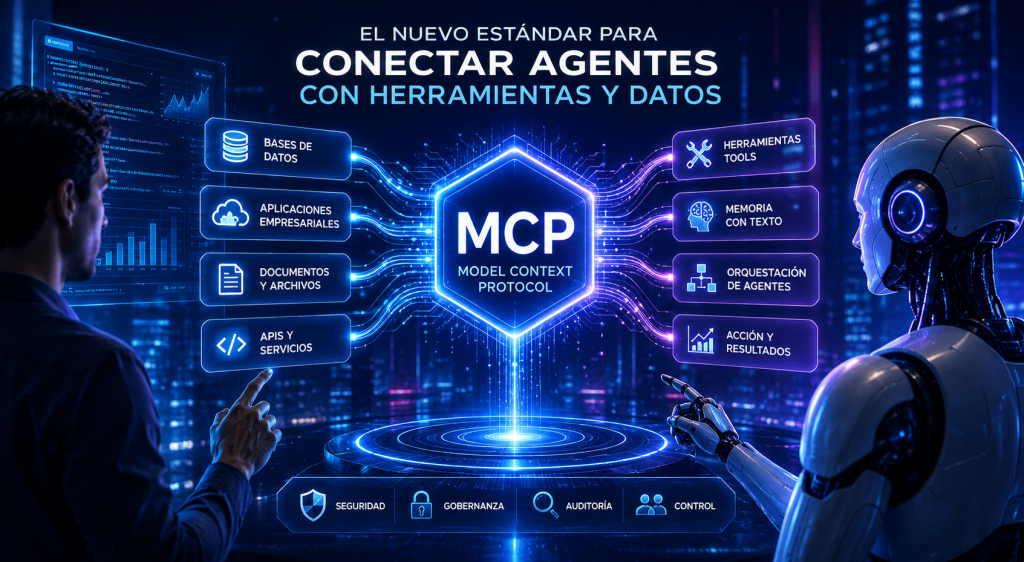
At the core of the architecture are MCP servers, which expose access to enterprise systems, databases, document repositories and business applications. Through these servers, agents can interact with external resources using a consistent protocol rather than relying on custom integrations.
Tools represent the actions an agent can execute. These may include querying a CRM platform, retrieving information from a knowledge base or triggering automated workflows. MCP also supports memory mechanisms that allow agents to maintain context over time, making interactions more coherent and enabling more sophisticated decision making.
Orchestration plays a crucial role in enterprise environments. Complex business processes often require multiple systems to work together. An agent may need to gather information from several sources, combine results and execute follow up actions. MCP provides a standardised framework that simplifies the coordination of these interactions.
The impact on digital workers is potentially significant. Organisations are moving beyond conversational assistants towards autonomous agents capable of completing end to end business processes. By reducing integration complexity, MCP accelerates the development of reusable and scalable digital workers that can operate across diverse enterprise environments.
As connectivity increases, security and governance become critical concerns. Agents with access to multiple systems require strong identity management, granular authorisation controls and comprehensive auditing. Organisations must also define clear policies governing which tools can be used, what information can be accessed and which actions may be performed autonomously.
MCP is still evolving, but it represents an important step towards a standardised ecosystem for AI agents. As enterprise adoption grows, open protocols such as MCP are likely to become foundational components of the next generation of intelligent digital workers.