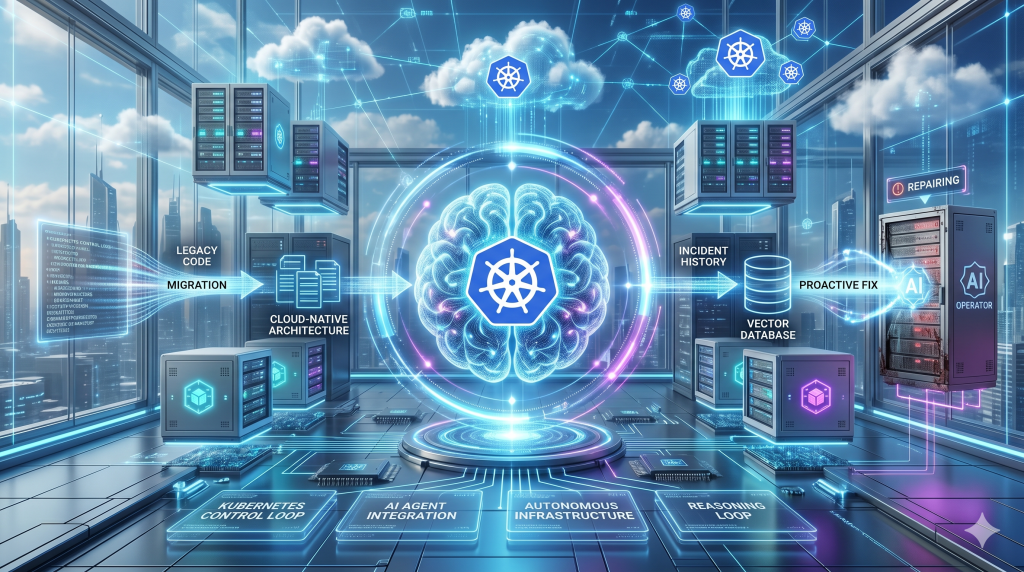
The management of Kubernetes clusters has moved from static configuration to systems that require faster and more precise decisions. Kagent addresses this challenge by integrating AI agents directly into the Kubernetes control loop. This architecture allows the system to go beyond executing scripts and instead use a reasoning loop to adjust infrastructure based on real-time operational context.
By using Custom Resource Definitions (CRDs), the AI acts as a native operator within the cluster. In application migration projects, Kagent analyzes source code and network dependencies to automatically generate deployment manifests and security policies. This approach reduces technical friction and ensures that moving legacy systems to the cloud is an organized and repeatable process, rather than a manual refactoring task.
A critical feature of Kagent is its ability to learn from operational history. The system indexes metadata, logs, and previous configurations in vector databases. When an anomaly occurs, the agent performs a semantic search to identify how similar incidents were resolved in the past. This feedback loop ensures that the system becomes more resilient over time. Instead of repeating the same errors, the infrastructure proactively applies learned fixes to minimize downtime and optimize resource usage.
Beyond incident response, Kagent helps organizations bridge the gap between high-level intent and low-level YAML configuration. It assists in rightsizing workloads by analyzing telemetry data and automatically adjusting resource limits or horizontal scaling parameters. This reduces alert overload for platform engineers and prevents over-provisioning, which directly impacts cloud expenditure and performance efficiency.
In the future, this integration will lead to fully autonomous environments where the infrastructure self-heals and scales based on predicted demand rather than reactive rules. Kagent enables a closed-loop automation where the data plane and the control plane are synchronized by continuous learning. Every action taken by the AI remains auditable and follows the declarative principles of Kubernetes, providing a stable foundation for complex enterprise operations.
Technical References
- Kagent Documentation – Core Architecture and API
- Kubernetes Operator Pattern and Controller Runtime – Kubernetes Documentation
- MemGPT: Towards LLMs as Operating Systems – arXiv Research
- FAISS: Efficient Similarity Search for Infrastructure Metadata – Meta Engineering