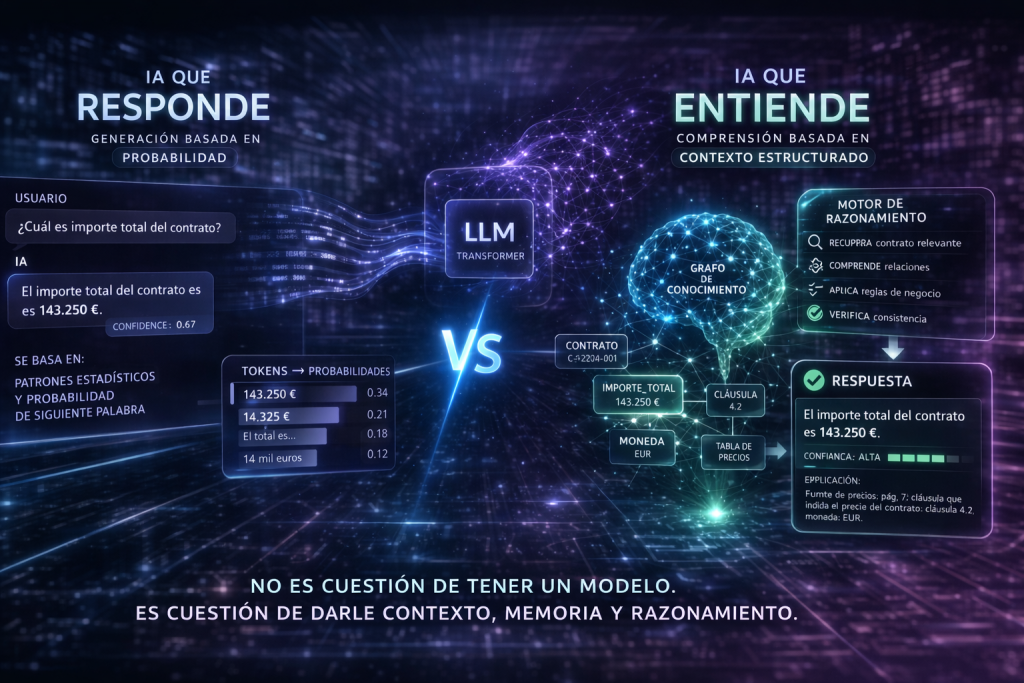
In modern artificial intelligence not all systems work in the same way. Some simply respond, generating text from probabilistic models that calculate the likelihood of the next token based on the previous context. In technical terms, the model does not search for information but estimates a probability distribution across all possible words and selects the most likely one according to the statistical patterns learned during training on very large datasets. This approach, typical of Transformer based large language models, makes it possible to generate coherent language, summaries and conversational responses in a very natural way. However, this writing capability does not imply real understanding because the model does not reason about the information. It reproduces statistical correlations, which means it can generate content that sounds plausible but is incorrect and it cannot guarantee logical consistency across different responses.
By contrast, an AI that understands incorporates structured context and no longer depends only on parametric knowledge. In these systems, before generating a response, the model receives an explicitly constructed context such as relevant document fragments, identified entities, relationships between concepts, business rules or information coming from a knowledge base. In other words, the model does not simply predict text but generates it conditioned by concrete information provided at runtime. This makes it possible to interpret complex documents, extract information consistently and support automated decisions with verifiable results. Architectures such as Retrieval Augmented Generation, the use of knowledge bases and structured processing pipelines are precisely the technical mechanisms that introduce this level of understanding.
The difference between responding and understanding is not only conceptual. It is critical in real environments. An AI based only on probabilistic generation can make mistakes when analysing contracts, produce inconsistent decisions in risk models or introduce incoherences in automated processes. When the system operates with structured context instead, it can maintain consistency, integrate multiple sources of information, respect business rules or institutional constraints and provide explainable results.
In practice, mature solutions combine both approaches. Probabilistic prediction provides fluency and natural language generation, while structured context provides coherence, reliability and reasoning capability. This combination is what makes it possible to build systems that do not simply respond well but operate reliably in complex and critical domains.
Technical references of interest
- IBM: In-Context Learning en LLM
- Power-IA:The predictive nature of LLMs
- Elastic: Context Engineering y RAG
- Zhang et al., 2024: Event reasoning with LLMs
- Mitchell & Krakauer, 2022:The debate about understanding in LLMs