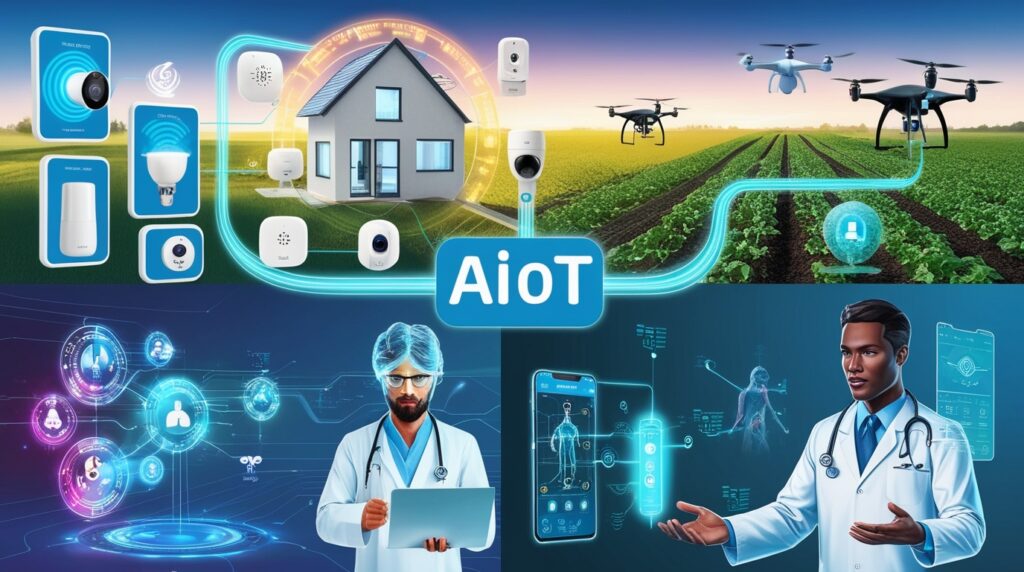
Scaling IoT is not a connectivity problem but a distributed architecture challenge. Connecting millions of devices is feasible, the real difficulty lies in processing their data with low latency and high efficiency. This is where AIoT emerges, AI models whose inference runs at the Edge rather than exclusively in the cloud.
On-Device Inference
Cloud-only processing introduces latency and failure risks in industrial systems, robotics, or computer vision due to continuous network dependency. A distributed architecture separates:
- Model training in the cloud, leveraging high computational capacity
- Inference on the device or Edge computing nodes
This approach reduces latency, minimizes network traffic, and removes constant connectivity dependence. It also relies on event-driven architectures, where devices transmit data only when a relevant event occurs.
Security at Scale
MQTT 5.0, maintained by OASIS, is the standard communication protocol in IoT. Its publish/subscribe model allows devices to send events only when data is available, while consumers receive them without persistent connections, reducing traffic and enabling scalability to millions of messages.
In large deployments, secure provisioning becomes critical. Automated onboarding using device certificates and cloud-based virtual representations (Device Shadows) enables secure lifecycle management and configuration synchronization without manual intervention.
Cloud Ecosystem for IoT on AWS
Platforms such as Amazon Web Services provide an integrated ecosystem covering the full IoT data lifecycle:
- AWS IoT Greengrass for Edge execution
- Amazon SageMaker for model training and optimization
- AWS IoT Core for scalable messaging
- AWS IoT SiteWise for industrial analytics
Together, they enable unified data acquisition, processing, analysis, and feedback from the Edge to the cloud.
Hardware Optimization for Edge Inference
Edge inference requires specialized AI hardware such as NVIDIA Jetson, which integrates accelerators to efficiently run computer vision and anomaly detection models. By combining optimized models, hardware acceleration, and event-driven architectures, IoT evolves from simple data collection to autonomous local decision-making.
Scalability ultimately depends on distributing intelligence, using efficient protocols, and implementing secure provisioning. The alignment of architecture, communication, and hardware is what transforms IoT into an intelligent system.
Technical References
- Systems architecture principles – All Things Distributed (Wegner Vogels)
- Communication Standard – MQTT 5.0 Official Specification (OASIS)
- AWS Cloud Implementation – AWS IoT Technical Documentation
- NVIDIA Jetson – Edge AI inference hardware platforms