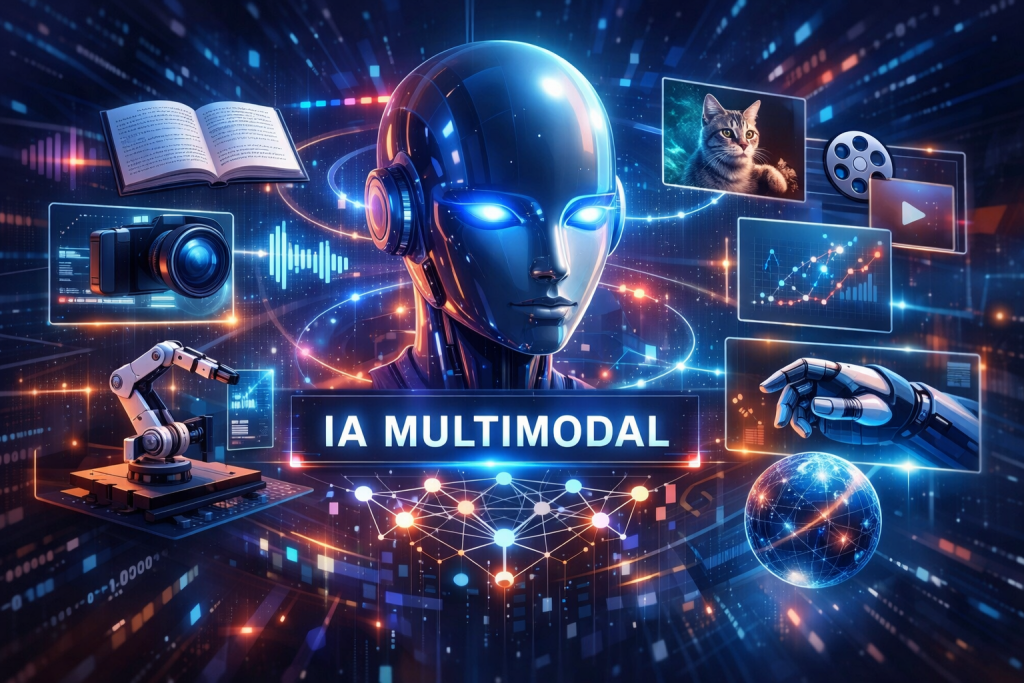
For years, AI specialized in a single modality, it understood either text or images. Today, multimodal models (like Gemini or GPT-4) are capable of processing language, vision, audio, and other data simultaneously. This evolution is key because it reflects how we interact in the real world. Humans do not process words or images in isolation; instead, we continuously integrate visual, auditory, and linguistic context.
What is a multimodal model and how does it work?
Unlike traditional systems, a multimodal model processes and relates different types of data within a single inference process. At a technical level, this occurs in three main phases:
- Specialized Encoders: Each type of data is processed and transformed into a mathematical representation or embedding.
- Shared Latent Space: All representations converge in a common space. This is where the model learns that the image of a car and the word “car” mean the same thing.
- Central reasoning: An LLM integrates all the information and generates a coherent response.
Business Applications
Corporate information is rarely presented in a single format. Multimodality allows us to solve complex problems by combining different sources:
- Advanced document automation: Joint analysis of text, tables, graphs, and images within files, contracts, or financial reports.
- Industry and predictive maintenance: The ability to cross-reference real-time sensor data with inspection images and technical manuals to detect anomalies.
- Customer service and natural interfaces: Virtual assistants that not only read text but can also interpret a photo sent by the user (e.g., a defective product) to offer precise support.
Major Technical Challenges
Despite its enormous potential, the adoption of multimodal AI faces significant challenges:
- Aligned data: Massive databases (like LAION-5B) containing exact information pairs (images with accurate descriptions) are needed.
- Computational cost: Training infrastructures to handle different data streams requires extraordinary computing power.
- Interpretability: In critical sectors like healthcare, it remains a challenge to understand and trace exactly how the model reached a conclusion by combining so many variables.
Towards Smart Digital Workers
Multimodality is redefining the limits of AI. For companies, the challenge is no longer simply to implement a language model, but to build intelligent workflows capable of combining all types of data to make much more precise and contextualized decisions. At Nuxia, we believe the next step is the evolution towards multimodal workers, systems that not only interpret their environment but also interact with it, use external tools, and execute complex tasks autonomously.
Technical References
- Radford et al. (2021) — Learning Transferable Visual Models From Natural Language Supervision
- Alayrac et al. (2022) — Flamingo: a Visual Language Model for Few-Shot Learning
- OpenAI — GPT-4 Technical Report
- Google DeepMind — Gemini Technical Overview
- LAION — Large-scale image-text datasets